Showing posts with label California. Show all posts

November 5, 2014

Ten Years Gone

A few months ago it occurred to me (as this sort of thing tends to) that we'd been driving Ludwig regularly since the late Summer of 2004--ten years. We'd actually gotten him very late in 2003 but between our academic and work commitments and getting him road-ready after a decade idle in a machine shed we weren't really drive driving him until right before we moved to California. That move was his first big trip with us, in fact.

Anyway, I also remembered it being a while after our arrival in the Golden State before we got a chance to actually camp in him and wondered when that anniversary was. A little sleuthing reveals that sometime in August or September, probably September, of 2004 he made his inaugural overnight with us at Gaviota State Park.

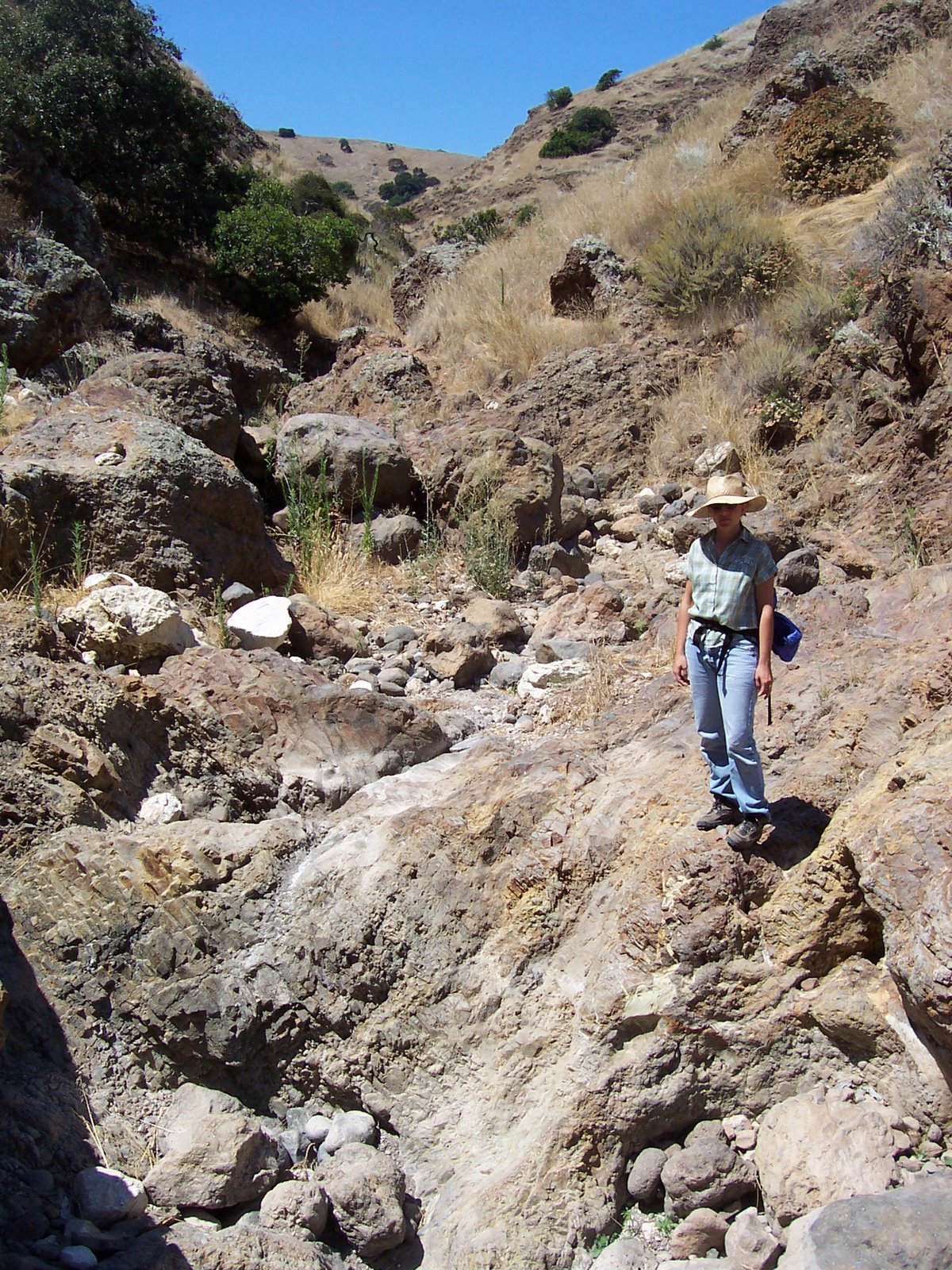
And what a campground it was! A barely-glorified parking lot for a beach. Not having much use for a beach, we explored some of the park's wholly different inland component; specifically, a 0.7 mile hike to an undeveloped hot spring.


The spring bubbled up prettily and smellily.


That's Las Cruces nestled in the distant chaparral, with CA Hwy 1 snaking beyond.

We lost two years of our lives to California during which time between the both of us we logged a paltry six more nights camping in him. Which leads to a final batch of statistics I'll leave you with: over those ten years, Melissa has spent 60 nights in Ludwig, I've spent 62, E has 47, and Stinkerton, 11. Not much in retrospect, but it gives us something to improve upon.

March 6, 2011

Santa Maria VW Show, Summer 2005

Ancient history, unearthed recently on our external hard drive.


The Santa Barbara Channel off port with Melissa at the helm, along US 101. A map of the trip is here.


The Gaviota Tunnel which, it seemed to me, delimited the spiritual Northern border of the LA malignancy metropolis, and of SoCal in general.


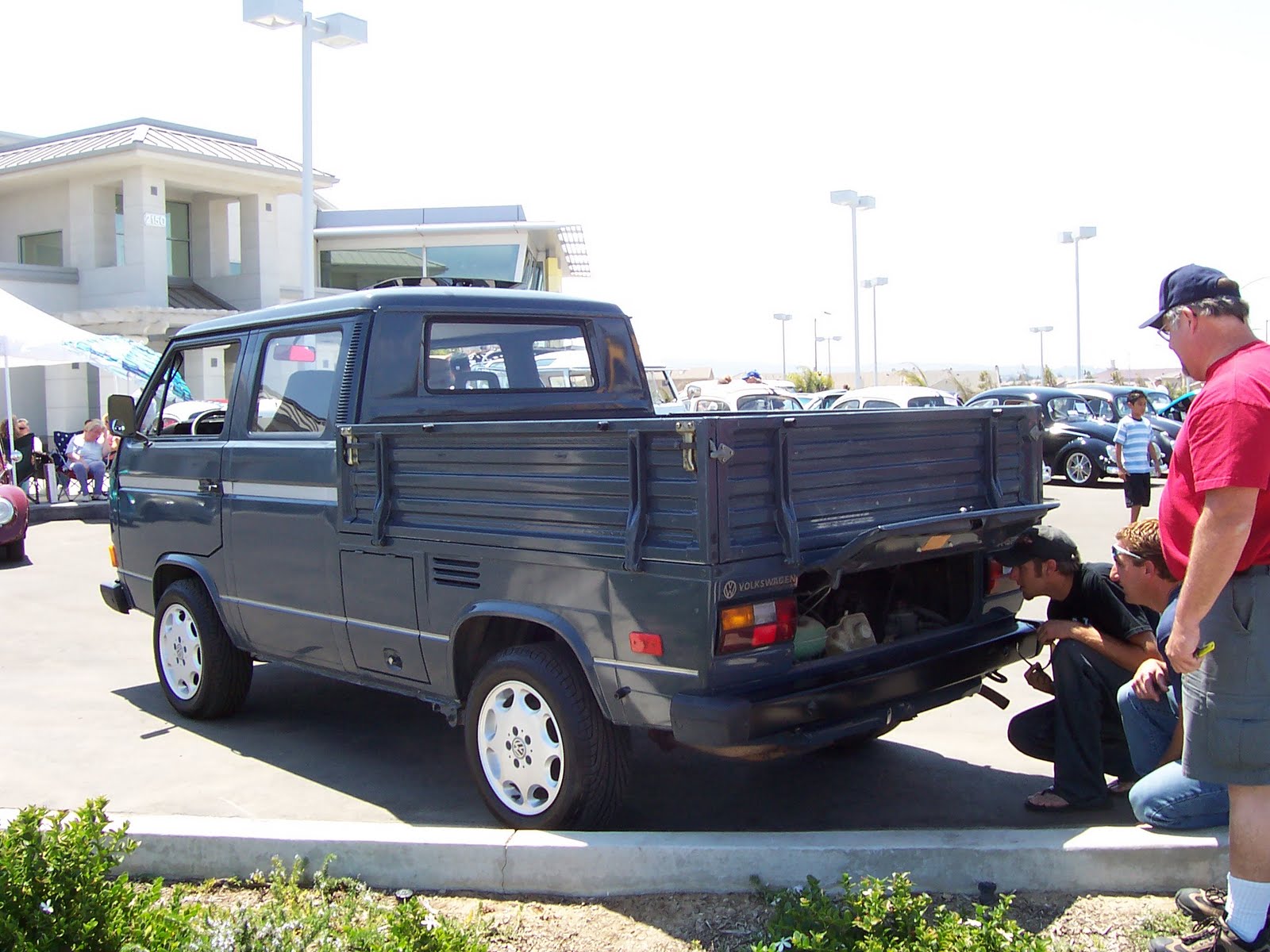
Crewcab Vanagon>cool.


The cast is an artifact of a bike wreck in Isla Vista a few days before (broken scaphoid).


This was one of the actual Beetles used in the most recent regurgitation of the Herbie series, starring Lindsay Lohan, aka LiLo. Don't I look uncomfortable in this picture? Well, I was. I remember this car's owner was really insistent that I get my photo taken in his car. It was super weird. 


Ludwig was an entrant in this show (curiously, the only bay window there if I remember correctly) but there're no pictures to prove it because the camera batteries died.


May 8, 2009

More Filler

I saw a Westy Vanagon at the grocery store the other day and its license plates ("GO WESTY") reminded me to make this post. It might look like an ad for them, but really it's not. It's just that we don't have much to post about right now, as the insurance situation is unfolding in re: Fang Fang and Gertie, and I have to keep mum about that. Ludwig is currently doing duty as our "daily" driver (scare quotes because we really don't drive anything daily), a job he doesn't mind, but sometimes he itches for the hum of fourth gear.

GoWesty sells refurbished Vanagons on their site and most of them are in the mid- to upper-five figures, but recently one went for over $120,000. Where do people get that kind of money? The really pricey ones are usually Syncros (4WD) like this one. These photos are from May of 2005 when I drove to Los Osos to get seatbelts for Ludwig.


GoWesty mostly deals in Vanagons and (blecccch) Eurovans, but they deal with bays sometimes too.

There's Ludwig, hanging out at GoWesty.

April 13, 2009

From the Archives

Very early August 2004 at 499A Cannon Green Drive.

February 21, 2009

Big Sur

When we lived in Goleta, California I went on a short trip with a three girlfriends. For some odd reason, I never made a blog post about the trip until now. So, be warned that this post might be a bit weird. The recount that follows will be my memory of what stood out from the trip, rather than an accurate and complete account of the events that transpired.


The destination of our trip was Kirk Creek Campground, near Big Sur California. I drove the entire way, obviously, since Mitch didn't go on this trip. Somewhere around Pismo Beach, the 101 (US Hwy 101) divides and there was a huge boulder in the middle. For some reason, roads built around rocks, and mountains or hills cut to allow road access, always leaves an impression on me. I think the appeal is that it's a real life example of Man vs. Nature that's more subtle than, say, an earthquake or tsunami.
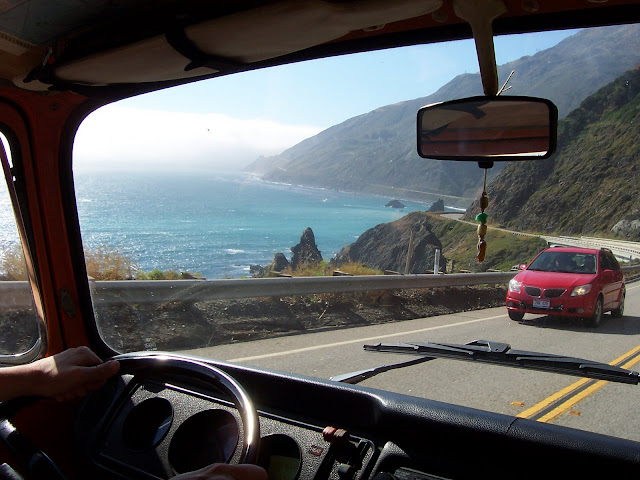

Traveling in Ludwig is pretty different than traveling in other vehicles, in a very practical sense. Slow driving, slow turning, slow braking, slow accelerating, and pulling over frequently to allow faster traffic to pass are all par for the course. I was extremely self-conscious and apologetic to my traveling companions, feeling as if I was expecting an unreasonable amount of patience from them, given that they might not have known what they were getting themselves in to agreeing to carpool in a 1974 bread-loaf Volkswagen Campmobile. Nevertheless, my nervousness was unwarranted as they were  relaxed, and seemed to actually enjoy the ride. However, the crappiness of our old tires was painfully obvious on the PCH (this trip happened before we upgraded Ludwig's tires to the Hankook RAO8s). He handled like I was like driving a bread-loaf on a waterbed.


This was our campsite. And this is Maura. She's wielding a ginormous bottle of booze she got for Mother's Day from her sons. Such good boys.

This old bus was parked directly across from our campsite. The bus wasn't a "real" camper. That is, it wasn't sold as a camper. It was a bus that someone gutted, and made some whacky interior and stuffed it inside, and then used the bus as a camper. It's lovely that VWs are so easily customized. Attached to the front of the bus is a wooden box, whose only purpose as far as I could tell was to hold a sauce pan as seen in the photo above. The bus's only occupant was one unkempt 50s-something man that seemed to spend most of his time hiding out in the bus. He exited the bus once to dump some gasoline in the fire pit, light a match and throw it down, WHOOOOSH!, eat something from the sauce pan, watch the flames for about 5 minutes, place the sauce pan on the wooden box, and retreat in to the back of the bus. The event was extremely short-lived and memorable.
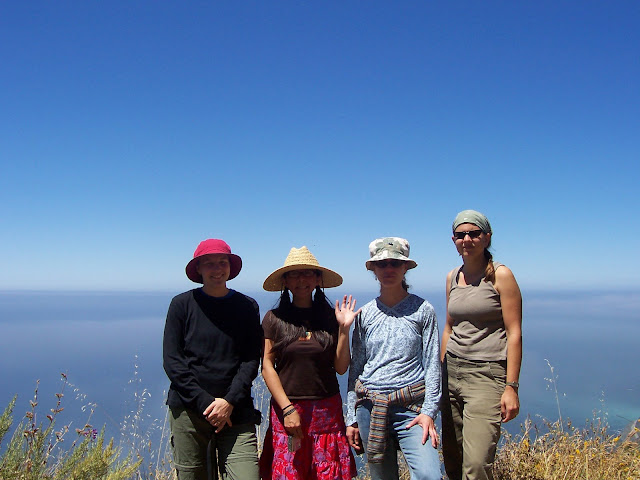
This was the lot of us. Erin, Thuy, Maura, and me (L to R). I'm not really the tallest, Erin actually is, the ground was sloped. The four of us are now scattered across the country in four different states.


This is the view of the campsite from one hike we took. If you click on the photo to view a larger version, you can catch a glimpse of Ludwig. I remember thinking that if I slipped and fell I might fall and roll and roll and roll all the way down in to the ocean. Scary.

This is Maura and Erin, on a different hike from the bird's eye view of Ludwig. See how crazy steep the hill is? Don't lose your footing, ladies.

This second hike led to a beautiful beach. The sights and sounds were incredible. I took a short video so I could share a less awesome than real-life version of the world's largest rock tumbler with Mitch when I got home.


At our campsite, I was horrified to find this:


a hideous creature, the mole cricket. Gross. We found these in our condo TWICE when living in California. They are horrifying, giant, and make a hell of a lot of noise when scratching around behind a bookcase. Disgusting.

But ocean + mountains + sunset always makes for a pretty ending to a camp-out.


On the way back to Goleta, we stopped at the beach near San Simeon where elephant seals are a popular tourist attraction. It was strangely awesome that the beasts were performing so near a giant permanent viewing area.


Yea, it was a pretty good trip.

THE END

January 28, 2009

Higher Learning

We moved to Santa Barbara (Goleta, actually) in the late Summer of 2004 so I could attend graduate classes in philosophy at UCSB. While I usually biked the three miles to campus, once in awhile there was cause to drive Ludwig. My office (such that it was) was in that building at left.

A beat but solid '70 or older parked in Lot 21, the same lot pictured above.

UCSB abuts the Pacific Ocean on two sides, making it (for what it's worth) one of our great surfing campuses. Accordingly, campus attire was often beyond casual. By that I mean the occasional co-ed would show up for class in a bikini top and a towel wrapped around her waist. It's entirely possible that such a Betty parked this splitty at Goleta Beach to hit the waves or the books.

Yet another Lot 21 denizen.

I never got used to palm trees.


One last shot of Ludwig at UCSB. In the distant distance are the Santa Ynez Mountains.

January 9, 2009

San Francisco

These are the ones we were quick enough to get shots of, during two visits to San Francisco in 2005 and 2006.

Making our way toward (or from?) what is allegedly the most crooked street in the world.


Taken at a parking lot by Buena Vista Park, my Westernmost point until October of last year.


Somewhere on the 101 between Sans Francisco and Jose, actually.

June 10, 2007

Solvang ACVW Show, 2004

We went to an ACVW show soon after arriving in SoCal, which was held in the "quaint" wine-country town of Solvang, West-northwest of (or just plain North of, if you're a SoCalian) Santa Barbara.

Beetles with two-piece rear windows are called "Split-Windows", not to be confused with ≤1967 Busses, which have a two-piece windshield and are called "Splitties". The last Split-Window Beetle left Wolfsburg in 1953.

The market for Splitties has gone through the roof in the last several years, with prices on immaculate examples like this one approaching $50,000. If you count all the windows on this jaw-dropping late 50s Deluxe properly, you'll come up with 23.

This was the oldest VW at the show, a 1946 or 47 Beetle. (I don't remember which it was, but I remember it was the oldest.)

If a bus was built before February 1955, it has a giant rear hatch and is called a "Barndoor" (cf. this engine hatch with that on the Deluxe above). Note also the ridiculously small taillights, and lack of a rear bumper.

One might notice that I'm more apt to take pictures of ACVWs from behind rather than from in front. I suspect that this is an unconscious manifestation of my preference for how they look from the back. In any case, the above is an example of why one might wish I'd keep doing so--the beautifully ugly Type 3 Ghia (aka the Type 34). That is a face only a mother could love. This one had something in the windshield claiming it was the lowest-mileage Type 3 Ghia in existence, and was all original. I'd love to see Melissa tooling around in one of these things, but they're super rare. The two we saw at this show (both 1965s, I think) are the only two I've ever seen in person.

I didn't pay attention to the show's rules and thought we might enter Ludwig. (It's often cheaper to just pay to get the vehicle into the show--which includes free admission for whoever's in it--than to buy tickets and just be a spectator.) But it turns out he was seven years too young, as the show was only open to ACVWs from the "classic" era, 1967 and older. So he had to spend his time exiled in the parking lot with this 1973 (Ludwig at right).

April 25, 2007

Ludwig's Drivers' Adventures-Santa Cruz Island

This post has nothing to do with Ludwig, VWs, or any cars at all for that matter. I'm breaking out of the mold temporarily to showcase our trip to Santa Cruz Island last summer before we pulled stakes and headed for Missoula. We had a ton of fun and since this blog is the easiest way for people to see what we've been up to, why not put it here?

On most days during a walk along the beach near our apartment you could see one or two of the Channel Islands, and on really clear days you could see three. We decided that while California has an abundance of National Parks we'd like to visit, Channel Islands National Park was the one we'd be least likely to visit after we moved due to the expense and logistics. The park was close--less than 20miles from our house as the crow flies. Of course, 19.5 of those miles are across the Santa Barbara Channel, a tract of the Pacific Ocean which impedes any easy access to the park. To be blunt, planning a camping trip to the park is something of a pain (for instance, an interesting Catch-22 is involved: before you reserve your campsite, you are strongly advised to book your passage on the boat to the island. But in order to book your passage to the island, the boat company suggests that you first reserve your campsite) and not something you'd want to do from afar. We secured an excursion through Island Packers and took off early in the morning.


Our camp at Scorpion Ranch Campground, on the Eastern tip of the island, was nestled among (non-native) Eucalyptus trees. We tried to keep an orderly camp, as the island's birds have become quite adept thieves.

Santa Cruz Island is pretty big--at 96 square miles it's the biggest island off of the West coast of the lower 48. Even the land in the distance in this picture is the island.

There are lots of sea caves along the coast of the island, including one of the largest in the world, Painted Cave. The cave in the above-right picture isn't that cave, though.


Here we are along the trail between Cavern Point and Potato Harbor, on the Northeast side of the island. A stretch of mainland California (between Ventura and Los Angeles) can be seen on the horizon under the brim of my hat, left of my ear.

I thought I knew what this plant was, but now I can't find it's name or anything. I think it's some kind of endemic succulent, but now I think I might be totally wrong. Whatever it was, the flowers were coated in a sticky gel.


In the distance is Anacapa Island (actually a tight chain of three islands), the most visited in the park because it's where the visitor's center is, and it's closest to the mainland. It's also the smallest of all of them. The hike along the coast was blessed by mild weather.


This grove of non-native cedars was planted a hundred years ago by Delphine, the young daughter of one of the island's owners. They teased her for planting trees in such a harsh environment (precipitation on the island is neither plentiful nor consistent), but here they are, a century later.


The mild temperatures along the perimeter of the island give way to an almost furnace-like environment in the interior. On our second day we hiked 6 miles over to the other side of the island to a place called Smuggler's Cove. It was hot and there was no shade at all. Along the path we saw dozens of mounds of rocks. We learned later that this part of the island had been cleared of them--by hand--so that the owners could try some potato farming. It's funny that they chided Delphine for planting cedars while they were trying to grow potatoes and corn under the same conditions. Most farming on the island was marginal at best.


This mountain range separates the Eastern (public) and Western (private; Nature Conservacy) parts of the island.

The path eventually led down to the cove, which had also been the site of another ranch house and a big orchard of olive trees (which were fairly successful). The trees on the horizon are olive trees.

I knew this shot was coming, and specifically prepared for it. The view faces directly South, which may not seem like a big deal. But this picture looks directly into the most empty expanse on the planet; from this vantage point the next landfall is on the coast of Antarctica, some 7400 miles distant.
[12.01.2019 edit: "Specifically prepared" for it--ha! I'm embarrassed to have to report on my younger self's cartological sloppiness here. The next landfall from this vantage point is in fact San Nicolas Island, of Island of the Blue Dolphins fame, 55 or so miles South. Beyond that, the next stop is Antarctica, I swear.]

The trail back up through the olive trees was pretty steep, as Melissa's expression attests.

They tried to drill for oil near this spot in the 1950s (it's only been a National Park since the 80s) but struck only water. It's terrifying to think what this place would look like if they'd actually found oil.

After a day of tough hiking (tough for us anyway), we strolled around the harbor near the campground. This is where our boat landed. Those rocks in the middle distance to the left are large seabird rookeries, and all that bright white stuff you see on them is just what you'd think it is--eons worth of bird guano.

The last day of our stay we went off to another part of the interior to try to see the Island Scrub Jay, a close relative of the Western Scrub Jay. Spotting one of these birds was one of the things that compelled us to visit the island, in fact. The Island Jay is half again as big as its more populous mainland cousin, and sports a shorter, bulkier beak. A ranger gave us the impression that the birds were really elusive, and that this was neither the best season or best part of the island to see them. We were a little dejected; we'd never get the chance to see these birds living in the wild again, but we'd planned on trying so we hiked off into Scorpion Gulch (above).

The birds like the native island oak trees that grow in gulches like these, so we found a patch, sat down and quietly waited. We really didn't know what to expect, and were soon rewarded with this bright fellow who noisily perched himself in a tree just a few yards from us:

Soon others were nearby. They weren't really scared of us, just warily curious. As a reward for our patience, they let us get some fairly close shots. 


They didn't seem to us to be all that much bigger than the mainland birds, but their beaks were significantly stouter, and their colors sharper. We were happy that they let us visit them, and sat among them for as long as our schedule would allow (the boat was taking us back that day).

Another famous endemic species we'd hoped to see, the housecat-sized Island Fox, made an appearance in camp the evening previous. We caught only a fleeting glimpse of one as s/he scampered right through the middle of camp but the light was fading and the fox was too quick, so we couldn't get a picture. The foxes were nearly driven to extinction in the last decades, here's the story: the ranchers who used to own the islands brought lots of pigs with them. When the ranchers left, lots of feral pigs were left behind. At some point in the 20th century, eagles from the mainland figured out that these wild pigs were an easy source of food, and came to the islands. Then they (the eagles) discovered the foxes and started preying on them too. The foxes had evolved in the absence of predators and the population was nearly lost to the eagles. Naturally, people with some sense thought that a good start to restoring the fox population would be to eliminate the pigs (who've also dug up and wrecked a lot of native vegetation). So while we lived in California, they started shooting all these pigs, and relocating the eagles. This being California, there was much protest by those who thought the pigs were being victimized, that their rights were being trod upon, etc. I don't know; it seems to me that the continued existence of the Island Fox is worth a lot more than the lives of some pigs. Species: important; individuals in and of themselves: not so important. That's the end of my rant.


Here's Melissa hiking back out of the canyon.

After visiting the birds, we packed up and waited for the boat back to Ventura. Luckily these pirates didn't pillage the campground.

Goodbye, Santa Cruz Island.